Tuesday, February 1, 2011

The Downfall of Alfred Dolge


For over a century leading American capitalists have recognized a responsibility to give back to the public a portion of the vast wealth they have accrued. Andrew Carnegie made his fortune in steel and set the tone for subsequent philanthropists by endowing libraries and universities. His foundations, like those of the Fords and Rockefellers, have continued to be a source of good works down to the present day. In this same spirit Bill Gates and Warren Buffett launched a campaign last summer to persuade their fellow billionaires to donate half their wealth to charitable causes.

Alfred Dolge was in some ways a very early example of this philanthropic spirit, but there was a singular difference, and I suspect that this difference is what eventually set in motion the plot that destroyed his dreams for Dolgeville. His goal was never just to make money, and he did not see the distribution of his personal wealth as an act of charity, something to be reserved as a worthy retirement project. Throughout his life he was an intellectual, fascinated by political and economic ideas. He read very widely and wrote continuously and was always eager to put in place economic systems that he believed could be a model for the entire country.

 Wilhelm Liebknecht, Dolge's "preceptor" 
and founder of the German Socialist Party

He was very much his father’s son. Christian Dolge was a close friend of Wilhelm Liebknecht, the founder of the German Socialist Party, and was imprisoned for five years for his role in the uprisings of 1848. Alfred Dolge wrote of Liebknecht as his “preceptor” from whom he learned the teachings of Karl Marx.  He also refers to his youthful reading of David Ricardo, John Stuart Mill and Adam Smith, the great apostle of the free market.  From such apparently contradictory ideas, he wove the theories of a just and equitable economic system which he put in place in Dolgeville.

Eleanor Franz, in the only biography of this remarkable man,  describes Dolge’s vision very succinctly:

What Dolge built grew out of his determination that children should no longer scavenge coal, or old men end up in paupers’ graves. It was his belief that a workman should be able to retire at sixty with a pension paid for by his employer as part of the cost of production. The security of such a plan, he wrote, “would allow the laborer to live better and be more healthy, keep his wife at home and his children in school. He could live up to his income and thus develop a higher manhood and superior citizenship.” Dolge saw employees eventually becoming partners in a business, so that a capitalist would no longer be enriched at the expense of his laborers. Even though he believed in hard work as a way out of poverty, it was never his belief that the poor remained poor because of laziness. What he aimed for was, in effect, a leveling of the economy to benefit everyone rather than solely the man at the top. (Franz, p. 23)
 
This was this vision that Dolge brought with him when he first saw the hamlet of Brocketts Bridge in April, 1874.  It is true that the East Canada Creek provided both the water quality and the power that he sought for his felt-making industry, but I am sure that he also was struck by its relative emptiness. This was a place where he could bring the skilled, mostly German, workers he needed to form a new village of his own design. He may also have been influenced by the nearby area’s large German-American population, descendants of 18th century refugees from the Palatinate, a fact to which he referred in later speeches.

 Alfred and Anna Dolge, c. 1868, from Dolge by Eleanor Franz

For 24 years Alfred Dolge pursued numerous business ventures with great success, never losing sight of his guiding vision. He bought the abandoned tannery where his great limestone factory soon rose, and began to produce high quality felt, piano hammers and sounding boards.  By 1879, he had installed Edison’s second electric turbine, the first to run on water power, and equipped the factory with automatic sprinklers and electric lighting. By 1881 he was manufacturing the first felt shoes and slippers.

 Thomas Edison, inventor of the world's first hydroelectric
turbine, installed at Dolgeville in 1879


As the need for lumber expanded, he built two sawmills and acquired 18,000 acres of the Adirondack forest. Complete pianos were being built by 1890 and a woolen factory was opened. A unique musical instrument, the autoharp, was another industry in the growing village now known as Dolgeville.

The 500 ft. Ransom Creek trestle on the Dolgeville & LF railroad 


And in 1892 a railroad, largely financed by Dolge, linked the village with the main line at Little Falls, replacing the 50 teams of horses that had previously been the only means to move raw materials and finished products. 

Each business success led him to introduce another step in his social and economic plan. Within two years of arrival in Brocketts Bridge, Dolge had set up a pension plan, the first of its kind, for his employees. Benefits ranged from 50% of wages for disability after ten years to 100% after ten years. If disability was work-related, fifty percent would be paid even without ten years of service. He provided life insurance, also unknown for working people at that time, on a prorated scale based on years of service. Sick pay and death benefits were part of the plan. In 1890 he introduced his “Earning-Sharing” Plan under which employees received a percentage of the company’s profits, to be reinvested back into the company until retirement. Losses were also charged against employee accounts. (Franz, chapter 3)

Dolge spoke frequently on the major social and economic issues of his day. When the Knights of Labor agitated for an eight hour day in 1886, he reduced work hours from ten to nine, explaining that further reductions would be possible with increased productivity. He worked hard for the Republican party and was among the strongest voices for a protective tariff, arguing that his well-paid workers should not be expected to compete against Germans or Frenchmen earning far less. 

He was an advocate for public education, endowing a new school and later becoming deeply embroiled in controversies over such issues as the mandated teaching of German as a foreign language. At the school’s dedication in 1887, he spoke of public education as essential to democracy and the only sure bulwark against radical agitation:

The future of this great country, the inviolability of our free and liberal institutions, can be guarded only by a rising generation, which by means of an excellent education, will not only keep the unruly element in check, but raise it up, elevate it, so that it will generate good and worthy citizens able to analyze and understandingly resist the false teachings of adventurous agitators and revolutionists.

He was far ahead of his time in calling for better education of teachers, at a time when many were teenage girls only a bit ahead of their pupils:

To build school houses, equip them properly, to hire the very best teachers at such a liberal salary that it is worth their while to spend their lives in this arduous and most responsible of all professions, is the duty of every community, may it be ever so small or poor . 

Dolge was also ahead of his time in advocating physical education in the school curriculum and did much to promote a form of gymnastics popular in Germany, known as turnverein. He built a gymnasium and clubhouse for the workers and their families. Many athletic competitions and celebrations, known as turnfests, were held in High Falls Park, which Dolge developed and donated to the village. At such festivities, Dolge made sure that plenty of beer was on hand, but was against saloons and stronger drink.

Commemorative stein from a Dolgeville Turnverein

(His many writings on economic and social issues were published by him in two, somewhat overlapping collections, now available via google books: The Just Distribution of Earnings and The Practical Application of Economic Theory. The books reveal his desire to spread his ideas, evidenced by the many speeches he made in the US and in Europe, as well as by the letters he wrote to numerous newspapers.)

And yet within the space of a week, in April 1898, all of Dolge’s enterprises collapsed. He was branded as a bankrupt and a fraud, compelled to hand over his thriving industries to strangers, and to leave Dolgeville forever. 

Richard Buckley, in his history of Little Falls, describes an incident from exactly one year before his forced bankruptcy that may have made Dolge a marked man. Speaking at a meeting of the University Club, chaired by D.H. Burrell, Dolge stated that “almost every conflict between capital and labor originates in the demand of laborers for a betterment of their condition.” He said that too many manufacturers subscribed to the notion that “profits rise as wages fall,” and argued that the recession of 1892 was due to a collapse in demand caused by the failure of Congress to pass a protective tariff that would safeguard high wages for workers.  In a remarkably prescient observation, Dolge said that “Capitalists must learn that wage earners of today are of greater importance to the community as consumers than as producers.”  (Buckley, p. 114)

One can imagine the shocked countenances of the wealthy gentlemen of Little Falls as Dolge made these pronouncements. And their mouths must have dropped even further when he went on to suggest a national industrial/labor senate, which would serve to arbitrate all disputes between workers and owners.

One year later the Herkimer County Bank, on whose board D.H. Burrell sat, forced Dolge to declare insolvency and to place his assets into receivership. The factories were closed for several months, a fraud suit was initiated against Dolge, and all the contracts with his workers were declared void. The promised pensions vanished and those already being paid stopped suddenly. 

Although The Little Falls Evening Times initially described the failure as a temporary adjustment, reflecting uncertainty in the money markets due to the Spanish-American War, the key role of Judge George A. Hardin as the named plaintiff for the Herkimer County Bank against Dolge & Son points to a conspiracy to bring down the one local capitalist who seemed to be an enemy of his class.  

Judge George A. Hardin, Courtesy New York Courts, 
Appellate Division Law Library, Rochester

In a farewell address to his workers Dolge explicitly accused Hardin and Schuyler Ingham, another member of the bank’s board, of causing the bankruptcy for their own profit. The rapid selling off of the properties, including the 18,000 Adirondack acres, for pennies on the dollar and the appointment of Ingham as director of a newly constructed felt trust suggests that it was more than Dolge’s anger speaking. And the venom of Hardin’s unguarded comment to the Little Falls Journal & Courier reveals a deep personal and political motivation: “Dolge is an anarchist, an atheist and a communist.”  He also attacked Dolge personally for backing the village newspaper, the Dolgeville Herald, and for building an expensive mansion. And when Hardin died three years later, Dolge wrote from California that the man was clearly a thief since he left a fortune of $800,000 although during the last 28 years of his life he never earned more than $10,000 a year as a judge. (Buckley, chapter 7)

Dolge gave his version of the events in a self-published book, The Story of a Crime, which Eleanor Franz quotes in her biography. The book is very rare and, according to Franz, most copies were destroyed. In the book Dolge blamed himself for trusting Ingham and Hardin, with whom he had been in business since the very costly Dolgeville railroad was first proposed in 1882. He maintained that the two told him they would handle the cash flow problem, and then foreclosed on him, even though his assets were twice what he owed. He said that he soon obtained loans from New York backers that would satisfy the Herkimer County Bank and the American Exchange Bank in New York, but when he told Ingham he had the funding, Ingham told him he was too late.

Dozens of attorneys were soon handling the mass of suits and countersuits that followed the collapse. A case of fraud against Dolge was dismissed, but not before a very revealing hearing was held in March, 1899. At that hearing Schuyler Ingham was questioned about a power of attorney that Dolge’s son Rudolf had given, at the urging of Hardin and Ingham, to a mysterious figure by the name of Robinson, associated with the American Exchange Bank. It appears that the default was triggered by a joint action of the Herkimer County Bank, on whose board Ingham and Hardin sat, and the New York bank where Hardin and Ingham’s man Robinson had a major interest.

A report in the April 12, 1898 New York Times stated that that while Rudolf was in South America, “his representative made application at Utica for dissolution of the firm and the appointment of a receiver.” This was evidently the mysterious Robinson. The Times writer voiced the general surprise at the proceeding, citing Dolge’s assets which far exceeded his liabilities. 

It is not clear how the Dolge enterprises were structured but it may have been a simple partnership between Alfred and Rudolph, the oldest of his five sons, who was then 29. Why Rudolf would give Robinson the power to initiate a suit against his father’s firm is not known. Perhaps there was a falling out between Rudolf and Alfred that led the son to go to Venezuela. Or perhaps he was simply naive. Or perhaps Rudolf had some secret which allowed the two men to blackmail him. 

At the heart of the collapse is a family drama which may never really be known. Rudolf was clearly a beloved son, given major business responsibilities in his early 20s, and his wedding in 1893 was celebrated in grand style. At the wedding, grandfather Christian Dolge called Rudolf “the crown prince of Dolgeville.” Strangely, however, he left the US for Venezuela four years later, claiming poor health, yet lived in apparent good health for many years, becoming active in Venezuelan industry, science and literature. Rudolf signed the fateful power of attorney on a quick visit back to the US in 1897, at which time he met with Ingham and Hardin, probably in New York, but whether he saw his parents is unknown. 

The question of what happened was a source of intense controversy in Dolgeville for decades, and although some citizens turned against Dolge, his loyalists, such as the volunteer firemen of the Alfred Dolge Hose Co., would not hear a word against him.  Whether the plot to destroy him was motivated by greed or personal hatred, or a mix, will probably never be clear. He may well have been over-extended in terms of loans, but it was the actions of the Herkimer County and the American Express banks, both under the influence of Ingham and Hardin, that brought him down – and profited both men. 

D.H. Burrell, from Nelson Green's
History of the Mohawk Valley

There is no evidence that D.H. Burrell, the founder of Cherry-Burrell, was involved in the plot although, in fairness, he was on the bank’s board and obviously had huge influence over the bank’s decisions. He was himself a more classic philanthropist, known as a fair employer, and his choice of charities were conservative. He endowed the local YMCA, the Presbyterian Church and funded the building of the Little Falls City Hall in 1916. But he is reported to have sharply questioned Dolge during his rather radical presentation at the University Club in 1897.

As to Dolge’s immediate reaction to the plot, he had no choice but surrender his holdings Although he called Wilhlem Liebknecht his mentor, he never really shared in Marx’s revolutionary dream of placing the means of production (and defense) in the hands of the workers. On the contrary, he took pride in keeping labor agitators out of Dolgeville. Unlike Wilhelm’s son Karl, who proclaimed the 1919 communist revolution in Berlin with Rosa Luxembourg and ended up assassinated by rightist gunmen, violence was not part of Alfred Dolge’s make-up. 

For all his love for German culture and his annual trips back to Europe, he was truly an American and believed that hard work would lead to prosperity for all.  But he never had a mindless faith in the free market and knew that the raw pursuit of profit had to be restrained or it would drive the working class into poverty. Thus, he would not have fit comfortably into either of today’s political parties.

The destruction of his dream had much to do with his own faith in human nature, in that he trusted dishonest men who took advantage of him and his son.  And although he left Dolgeville in sorrow and never returned, his sunny spirit has, I am convinced, remained in the village he created. Hard-working people continued to lead productive lives and the kinds of bitter strife that afflicted Little Falls and other industrial towns never came to Dolgeville.  He did not, despite Hardin’s bitter prediction, commit suicide. He went on to California where he founded a second Dolgeville in what is now greater Los Angeles, continued to write, and made a sufficient financial recovery to live comfortably, dying in 1922 on a round-the-world trip with his beloved Anna.


 Anna and Alfred Dolge with friends, hiking in the Harz Mountains
of Germany in 1921, from Dolge by Eleanor Franz

And as for Judge Hardin?  

I grew up in Little Falls a few blocks from where Hardin had built a lavish mansion on Gansevoort Street facing the Western (now Burke) Park.  By the time I was a boy, all that remained of the mansion was a wall and a lone gazebo in a vast empty lot. And when I asked my father what was once here, he told me that a bad man used to live there but he had died in great terror over his many sins.


My novel on the later life of Alfred Dolge, Mr. Dolge's Money,  can be found on Amazon in paperback for $9.95 and on kindle for 99 cents. The story centers on Alfred and Anna's grandson Joseph, or Jose, who is imagined as a son of Rudolf's from Venezuela. At the very end of World War I. Alfred dispatches the young man on a mission across newly Bolshevik Russia into a Germany in the midst of its revolution. In the course of Joseph's attempts to recover his grandfather's hidden fortune, he narrowly escapes from Lenin's secret police and the early Nazis and their followers from the occultist circles of Munich.

 My  short factual biography of Alfred Dolge is also available on Kindle for 99 cents and as an illustrated paperback for $7.95. The Kindle version can  also be read on tablets,smartphones and PCs by downloading the free Kindle app. Amazon Prime members may also borrow the story through the Kindle Owners Lending Library.


SOURCES:

Eleanor Franz, Dolge, available from the Herkimer County Historical Society

Richard Buckley, Unique Place, Diverse People, a history of Little Falls available from the Little Falls Historical Society

Works by Alfred Dolge, available on google books

The Just Distribution of Earnings, So-called Profit Sharing (1889)
The Practical Application of Economic Theories in the Factories of Alfred Dolge & Son (1895)
Pianos and Their Makers (1911)

FOR ANOTHER PERSPECTIVE ON JUDGE HARDIN:
See my novel, Roxy Druse and The Murders of Herkimer County, in which the judge makes several appearances. Available at Wilderness Hill Books.

Wednesday, January 12, 2011

The enlightened capitalism of Alfred Dolge


 Bust of Alfred Dolge at the Dolgeville Village Hall

Clearly, the socialists and anarchists who led the Little Falls strike in 1912 cannot offer a model for restoring prosperity to our region.  The Russian revolution of 1917 forever branded socialism as a dangerous form of tyranny in the minds of most Americans. And even now, a century later, calling the current president’s health care policy “socialist” is a sure way to discredit it in the minds of many citizens.  Even if a more rational and cooperative organization of the economy could help us, a majority of the people will simply not accept this possibility.  

But unrestrained free market capitalism has spelled economic disaster for Upstate New York, and the current bipartisan enthusiasm for cutting taxes on the wealthy is only a recipe for ever-greater inequity. Perhaps, then, it is time to look to our past for solutions that combine a for-profit system with a reasonable concern for the well-being of working people. And that brings to mind the long forgotten Alfred Dolge.

Dolge was no socialist, but he believed that the health and well-being of his workers was the necessary foundation for his own prosperity. An industrialist and founder of the village that bears his name, he had read both Karl Marx and Adam Smith as a young man in Germany, and combined those two apparently contradictory thinkers in his own unique vision. 

 1890 view of Dolge's mill, courtesy Village website

 The same view, 120 years later

The industrialist came to New York City as a young man, having apprenticed as a piano-maker in Germany. At first specializing in the import of felts and wires for the manufacture of pianos, he decided to create his own industrial village for the production of the piano components he had been importing. After an extensive search though the north east, he settled in 1875 on what was then the tiny hamlet of   Brocketts Bridge because the East Canada Creek offered both water power for his machinery and the water quality needed for washing felt.

He kept his large shop on 13th street in Manhattan and commuted by the night train each week, walking the final six miles from the depot in Little Falls before he built his own railway in 1892. Starting operations in an old tannery, he was soon at work on the beautiful limestone factory that is still the heart of the village, drawing skilled craftsmen and their families, many from Germany. 

As his work force grew into the hundreds, Dolge initiated a profit-sharing system for his employees, providing for disability payments, life insurance and an old age pension in 1876.  Bismarck sought his advice when Germany developed the world’s first social security plan, and the Social Security Administration recognizes Dolge’s role as a forerunner of today’s system.

Intake for recently restored hydroelectric generator 
at the Dolgeville Mill

 He was an admirer of Thomas Edison and put into operation the first electric dynamo run by waterpower in 1879,  which provided electric lighting for his mills, later extending it to the entire village.  Dolge also bought land for a park which he gave to the village, and donated a school and community club house.  

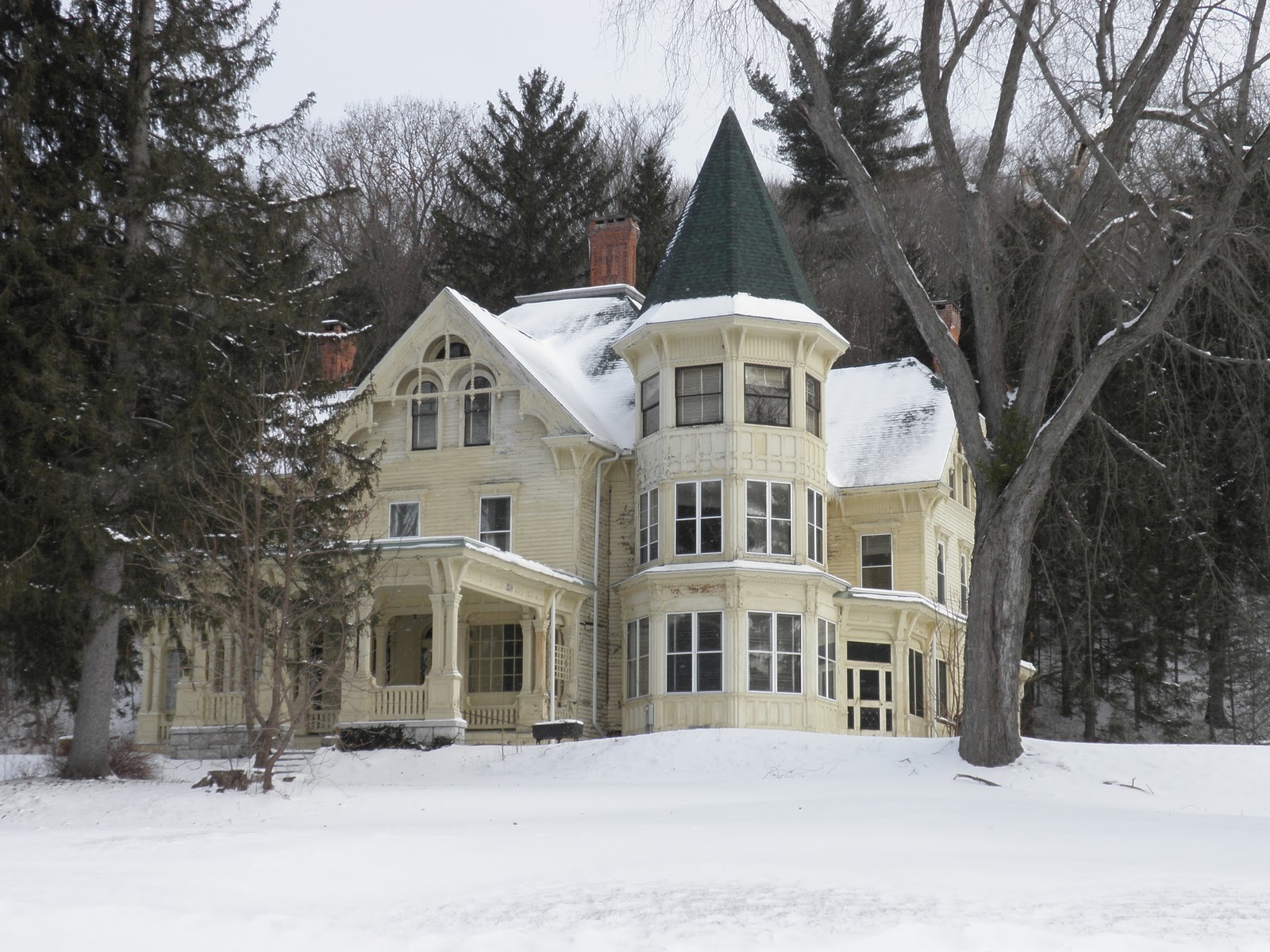
 The Dolge Mansion

Alfred Dolge enjoyed his wealth and built a mansion just across the East Canada Creek from his factories. He was always a workman at heart and spent much of the day on the factory floor, but he was also a great reader and writer. He spoke widely and wrote on subjects ranging from education and physical fitness to socialism and the protective tariff. (He saw the tariff as an absolutely essential way to protect his workers from unfair competition by low wage workers overseas – a position that no modern politician is willing to take.)

 old postcard of the Dolgeville & Little Falls RR


view of the same section of the abandoned railway today

Curious about traces of the utopian society created by Dolge, we followed the wintry roads north from Little Falls to Dolgeville, roughly parallel to the route of the Little Falls & Dolgeville Railroad, which was sold for scrap in 1964.

Arriving in Dolgeville, we located the Founder’s bust in front of the Village Hall and headed for the complex of factories built by Dolge in 1882, and later home to Daniel Green Felt Shoe Company until it shifted production out of town in 1999.  There we found Charlie Soukup, hard at work sanding the floors of the old mill.


Charlie Soukup at work


Charlie came from Florida to buy the 23 mill buildings several years ago.  After experimenting with an antiques center and a furniture store at the site, Charlie is now committed to creating at least 40 very original condominium apartments in the main mill building. I couldn’t help but compare him to that other entrepreneur who came here inspired by his own unique vision 140 years ago.

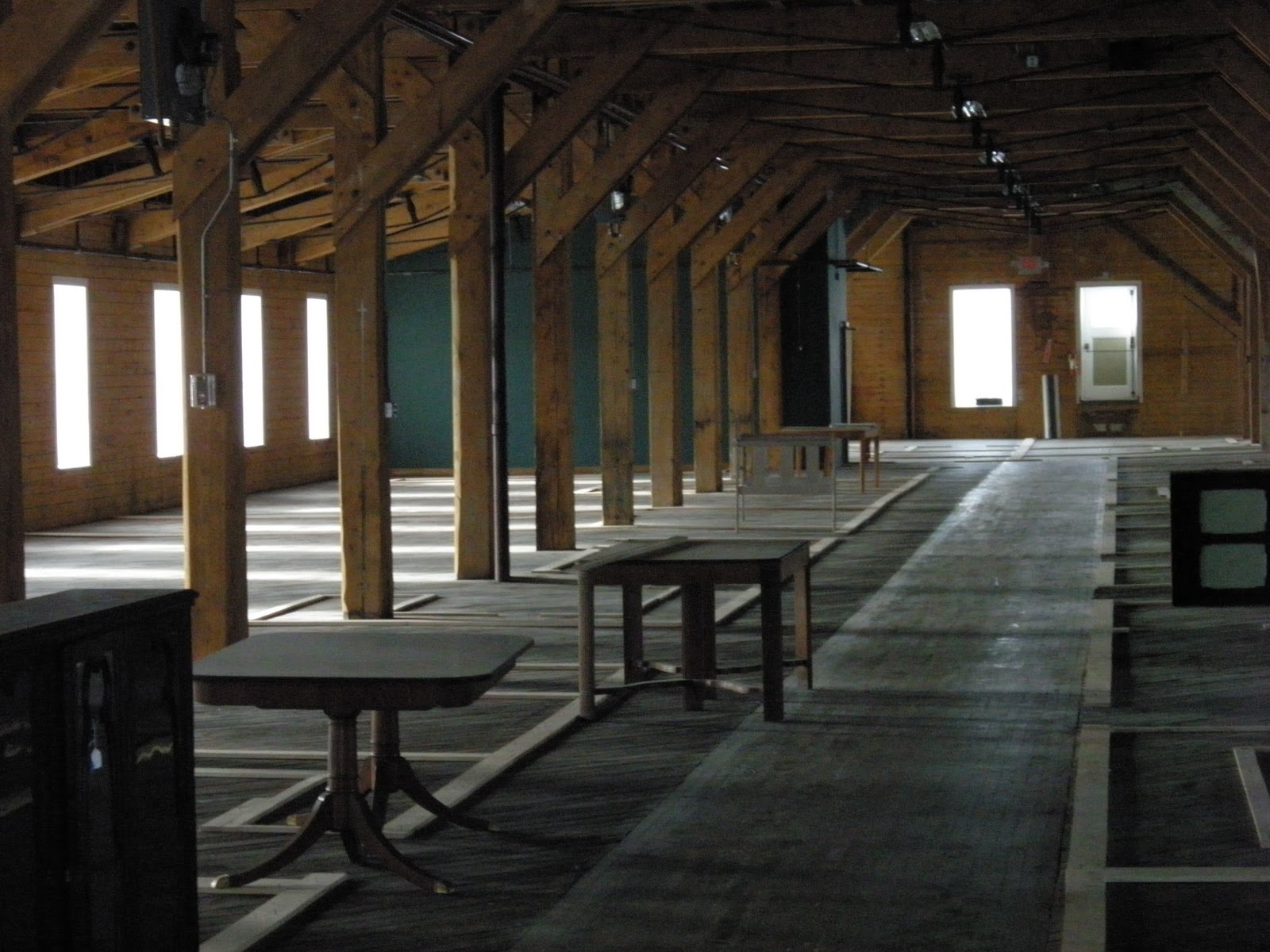
 40 condos are planned for the main mill

Charlie  interrupted his work to take us on a tour of the structure. He pointed out many examples of the great craftsmanship shown in the construction of the mill as evidence of Dolge’s extreme attention to the details of quality control. He told us that Dolge kept very detailed records of every aspect of the mill’s construction and operation.


  Layout for condo apartments on the mill's third floor

 Model condo unit features original beams, flooring and limestone wall

Charlie Soukup has made major investment in this project, hiring local people to clean out the old mill and ready it for renovation. The model condo which he recently completed is a remarkable example of creative use of vintage materials. The shelving and walk-in closet is constructed from lumber used at the mill. The handcrafted furniture also makes very effective use of old machine parts. And the view of the rushing creek is impressive. Although he plans to offer the one-bedroom unit for about $200,000, it would command well over a million dollars in New York or Boston.

Charlie said that he often wonders about what Dolge saw here so many years ago. Although I was eager to explore the issue, he didn’t want to speculate about whether it was Dolge’s own misjudgment or a conspiracy by his fellow capitalists that finally brought him down.  The risks of any great venture, then or now, are always high.

However, I do think that Dolgeville may well thrive in coming years, and I have high hopes for Mr. Soukups’ ambitious project. In contrast to most of the region, this village has not suffered excessively in the current economic downturn. Much of the local economy centers on the renewable resources of the Adirondack forest, and lumberyards and woodcraft industries remain strong.  The family-owned Rawlings company continues to produce the high quality Adirondack bats favored by so many major league baseball players. And just north of the village, a $200 million wind farm has recently gone into operation generating clean energy.


Adirondack bats are still made in Dolgeville


Dolgeville native Hal Schumacher pitched 
for the New York Giants and was an executive 
for the Rawlings company.

As to the nature of the society created by Alfred Dolge, its lessons for our own time, and the mysterious events surrounding  his downfall in 1898, that  will be the subject of a future posting on this site.


My novel on the later life of Alfred Dolge, Mr. Dolge's Money,  can be found on Amazon in paperback for $9.95 and on kindle for 99 cents. The story centers on Alfred and Anna's grandson Joseph, or Jose, who is imagined as a son of Rudolf's from Venezuela. At the very end of World War I. Alfred dispatches the young man on a mission across newly Bolshevik Russia into a Germany in the midst of its revolution. In the course of Joseph's attempts to recover his grandfather's hidden fortune, he narrowly escapes from both Lenin's secret police and the early Nazis and their followers from the occultist circles of Munich.

 My  short factual biography of Alfred Dolge is also available on Kindle for 99 cents and as an illustrated paperback for $7.95. The Kindle version can  also be read on tablets,smartphones and PCs by downloading the free Kindle app. Amazon Prime members may also borrow the story through the Kindle Owners Lending Library.

Sources:

Village of Dolgeville website

 Richard Buckley, Unique Place, Diverse People
Eleanor Franz , Dolge

Wednesday, January 5, 2011

Socialists, Anarchists & the Little Falls Textile Strike of 1912

Redco strikers at Hansen Island bridge, 2007
courtesy the Union Review


 On November 1, 2007 fifty-one workers at the Redco plant in Little Falls went on strike in response to a company decision to deny new workers the kind of health and pension benefits that had made Redco, and its predecessor companies, desirable places for lifelong employment. Located on the tiny island where Christian Hansen first began to manufacture Junket custard in 1891, the plant was sold to  Salada in 1958, then to Kellogg in 1969, and in 1988 to a German-based transnational, the Teekanne Group
Hansen's Island, site of Redco plant

Despite the multiple owners, Hansen’s Island continued to be a good place to work for over a century, and the workers evidently felt their value to the company would make a strike winnable. However, their attempt to assure a middle class living for those who came after them was no longer the way the American dream worked.  With only fifty-one workers locally and a parent union of only a couple thousand, the strikers had no effective weapons at hand.  The BCTGM union did file a complaint with the National Labor Relations Board and Homeland Security alleging illegal use by Redco of German nationals as scabs, but this charge was quickly dismissed. 
My impression is that the strike dragged on for over a year, but I am not sure what happened to the 50 strikers, if they eventually went back to work, or lost their jobs. Efforts to get any kind of statement from Redco or the Bakery, Confectionery, Tobacco and Grain Millers union have been unsuccessful, but perhaps readers of this blog can provide an update.


The  strike by longtime Little Falls residents  against a giant, foreign-owned corporation was the latest, and perhaps the last, echo of the fierce struggles that once dominated the economy of the Mohawk Valley. Nearly a hundred years ago, 2000 largely female textile workers went on strike in Little Falls under the banner of the anarcho-syndicalist Industrial Workers of the World, attracting national attention and winning a significant,if transitory,  victory. In contrast to the "bread-and-butter" unions that gained respectability in the 1940s, the IWW favored mass organization of all workers into "one big union" as a prelude to taking over the entire economy and establishing a utopian society.

The most complete and easily accessed source for information on the 1912 strike is Richard Buckley’s history of Little Falls, Unique Place, Diverse People, which is for sale at the Little Falls Historical Society Museum. Richard spent years poring over old records and newspapers and his book is very well sourced. Copies can be purchased by mail order.

Young women and children were the primary work force of the textile industry that developed in Little Falls during the later 1800s. Many workers had a story like that of my grandmother, Jennie McTiernan, who left school for the Gilbert knitting mill  at 13 when her father died, leaving behind a pregnant wife and  six young children. Working conditions were abysmal and my grandmother was not shy in describing the horrendous noise of the machines,  and the sexual abuse practiced by mill owners and their managers.  The only time reforms were considered was in response to tragedy.

It was the death of 146 women in the Triangle Factory Fire in New York City in 1911 that finally got the state legislature moving, although some reforms tended to have unforeseen results. As soon as a law reducing the work week for women from 60 to 54 hours  was enacted, the owners of the Gilbert and Phoenix knitting mills reduced the pay of women to match the shorter hours. Since the workers were already living at a near- starvation level, as documented in a recent visit by the state’s Factory Investigating Committee, the women were outraged. On October 9, 1912 eighty of them  spontaneously walked out of the Phoenix Mill in protest. At this point there was no organized strike, but it is possible that brutality toward the strikers by the owners and by the local  police may have ignited a much larger walk-out, eventually including all 1000 workers from Phoenix and another 1000 from Gilbert’s.
 Socialist organizers came by train from Schenectady on October 13 and  the next day a number of them were arrested for making speeches in Clinton Park adjacent to the Phoenix Mill. On October 15 George Lunn, the Socialist mayor of Schenectady, was arrested by Police Chief James “Dusty” Long for making a speech in support of the strikers.

 
Chief "Dusty" Long, at right,
courtesy LF Museum

 The rapid appearance in Little Falls of the Socialists, who were at that point becoming a major political party nationally, may have been in response to a call for help from Helen Schloss, a nurse specializing in the treatment of tuberculosis. She had been hired by the “Fortnightly Club,” an organization of wealthy women including the Gilberts and the Burrells, who were probably unaware of her earlier work with the Socialists in Malone, NY. When the Factory Investigating Committee came to Little Falls that August, Miss Schloss had provided investigators with graphic evidence of unsanitary conditions in the factories and tenements on the South Side. Once the strike began, she was very active in its support and was later arrested.

 Women textile workers, circa 1912, unknown location

According to Richard Buckley, local press and clergy actively opposed the strikers, most of whom were immigrants from southern or eastern Europe. Police Chief Long, a friend of my grandfather, made no excuses for his attempts to deny free speech and assembly rights to strikers and their supporters:  “ We have a strike on our hands and a foreign element to deal with. We have in the past kept them in subjugation and mean to hold them where they belong.”

Long’s efforts to silence free speech failed as socialists sent hundreds of supporters to town, leading to mass arrests beyond what the city could manage. At the same time the first organizers of the Industrial Workers of the World arrived and established committees for each factory and subcommittees for each ethnic group. By October 22 a Strike Committee was up and running, relying on democratic procedures of motions, amendments and vote counts. By the 24th the strikers voted to affiliate with the IWW and were awarded with a charter as Local 801, the National Industrial Union of Textile Workers of Little Falls.

The IWW  were far more radical than the Socialists but the two organizations often made common cause at this time. Although the Socialists favored an electoral path to power, the “wobblies” were anarcho-syndicalists, and envisioned a new society formed by direct expropriation of the means of production by worker organizations. But they knew how to organize, especially among groups who spoke many languages.


 Gilberts Mill employed 1000 workers at the time of the strike

Marching under the banner of the IWW on October 25, the strikers paraded in a great circle around the Gilbert and Phoenix Mills. The better-paid male “American” workers of the Snyder bicycle plant attempted to attack the largely female and foreign-born strikers, but newly hired police deputies managed to keep the two sides apart.

The daily parades under the IWW banner continued until a major clash occurred on October 30. According to Robert Snyder’s “Women, Wobblies and Workers Rights; the 1912 Textile Strike in Little Falls NY,” as quoted by Richard Buckley: "As Chief Long and his deputies clashed with the strikers, special police and patrolmen mounted on horses closed in on the largely unarmed pickets with their clubs. During the riot, a local police officer was shot in the leg, a special policeman furnished by the Humphrey Detective Agency of Albany was stabbed several times, and numerous strikers were beaten, some into unconsciousness."
Mill and South Ann Streets today, looking south from the site of  Clinton Park.
The Phoenix Mill was located at what is  now the parking lot in the foreground

A running battle ensued, with the police pursuing strikers across the river into the south side, where most of them lived. The police then broke into the strike headquarters at the Slovak Hall, smashed the place up, and proceeded to make mass arrests. Helen Schloss, by now considered a ringleader, was arrested a mile away. The police brought in three doctors to “examine her sanity” but she had a lawyer who soon secured her release.

 Jailed strikers, from The International Socialist review

Even though all 24 members of the Strike Committee, including Ben Legere, had been arrested on October 30, and some were held for over a year, the strike continued.  Matilda Rabinowitz, a diminutive Russian-born IWW organizer, joined forces with Helen Schloss and the two young women kept the strikers united in the face of this setback.

Women and girls from the Gilbert Mill, 1911

Together, the two women had an entirely female picket line up within a day of the mass arrests. “Big Bill” Haywood, a founder of the IWW arrived few days later to organize the “Little Falls Defense League” to provide living expenses and legal support for the strikers. Haywood, Schloss and Rabinowitz set off on a speaking tour of the north east that month to raise the funds that kept the strike going into the winter months. The anarchists Carlo Tresca and Filippo Bocchino also came to Little Falls to help organize the Italian-speaking strikers.


 Carlo Tresca, anarchist and later opponent of Mussolini, 
rallied the Italian-speaking  strikers in Little Falls

As Christmas neared, Matilda Rabinowitz and Helen Schloss won a public relations victory by announcing that the children of strikers would be sent away for the holidays to join Socialist families in Schenectady. With the newspapers publishing reports of the embattled mothers and their children, Albany politicians were moved to act. Just after Christmas, the state Board of Mediation and Arbitration held three days of public hearings in Little Falls.

Big Bill Haywood (in derby hat) leading IWW
marchers in Lowell MA in 1912
courtesy, Library of Congress

The strike ended on January 3, 1912 on terms set by the Board that were favorable to the strikers: (1) The companies were to reinstate all workers (2) There was to be no discrimination against  strikers (3) All men and women working 54 hours are to receive pay formerly paid for 60 hours.

However, the long decline of Little Falls began only seven years later when the Phoenix Mills closed and moved its operations to North Carolina, and by 1930, city population had dropped by 2000. The Phoenix  building, later occupied by the Allegro shoe factory, was eventually replaced by a parking lot, and Gilberts was closed decades ago.

The victory of the women of Little Falls in 1912 was a transient one, and within five years the democratic American Left had  been silenced in "The Red Scare" campaign led by both mainstream parties. In subsequent decades, the manufacturing base of the country was systematically dismantled by  capitalists lacking in any loyalty to the United States and its people, while both parties celebrated the "free trade"policies that made it all possible.

And by 2011, as the self-described  socialist senator from Vermont, Bernie Sanders ,recently noted, 90% of America’s wealth is owned by 1% of the population. 


And what became of the strikers and their leaders?

Certainly, many of the strikers remained in Little Falls, and possibly their descendants have family stories of the stirring days of 1912.  Richard Buckley mentions the names of a few of the strikers  whose family names were familiar ones in Little Falls in subsequent years: Susie Mucica and Tena Klc were arrested for throwing pepper at the police.: Annie Slavik and John Matis lodged a complaint about police vandalism at Slovak Hall; Louis Marosek spoke for the strikers at a public meeting.

The radical organizers moved on to the next industrial battle, and there were plenty just before World War I, and there is a record of their journeys.

Bill Haywood described the Little Fall strike in The International Socialist Review, and provides details on the roles of Helen Schloss and Matilda Rabinowitz, as well as on the support provided by Helen Keller. Haywood was one of the many Socialists and Wobblies targeted in the 1917-1919 Red Scare and fled the country, ending his days unhappily in the USSR.  Interestingly, the 1917 Espionage Act used to silence the socialists and anarcho-syndicalists is the same law being considered by the Obama administration for the prosecution of  Wikileaks founder Julian Assange.

Helen Schloss' rationality and feminism  is evident in  letters to the New York Times, published four years before her arrival in Little Falls.  A correspondent informed us that the following information on Helen Schloss had been posted by Bob Albrecht of Little Falls on Ancestry.com.

“Helen Schloss was born in Vilna, Russia, was the daughter of a rabbi, attended the Rand School (NYC), was a public health nurse in NYC, Malone, and Little Falls, NY. She was a Socialist, friend of Helen Keller. She was a union supporter and worked with Matilda Rabinowicz and Big Bill Haywood. Her arrest record follows her across the country. She also was a speaker at a NYC Suffrage Rally in NYC. She set up medic tents at strikes in Colorado and traveled to Russia with the Friends Service Committee around 1920. There she served as a nurse to those in the midst of the civil war. And then… her trail fades until her death in 1965. I can connect her to no one. Any help out there?”

 Matilda Rabinowitz (later known as Matilda Robbins) went on to play a role in the defense of Sacco and Vanzetti and was a UAW organizer.

 Matilda Rabinowitz


After publishing this article I heard from Matilda's granddaughter Robbin Legere Henderson who shared the above  photo of Matilda and told me the following:

I think this photograph  is fairly contemporaneous with the period of the strike, but I think it might have been taken as much as 5 years later, because she writes that one of the reasons she was not identified as an organizer by the police and the private detectives  when she entered Little Falls, was because she was taken for a child. She was only 25 when she organized the strike, and she appears older in this photo. My mother, Vita, was born in 1919, and I think this photo was taken well before that, because by then my grandmother had even shorter hair. You can see that she was quite beautiful, and not the least dowdy. She was also very small, only 4'10".

One of the few mementos I inherited from my grandmother is a golden locket presented to her on her birthday, January 9, 1913. It is inscribed "To Matilda from Little Falls Strikers, 1-9-13". Inside is a baby photo of my mother and a lock of her hair--very Victorian.

Little Falls was her organizing debut, and she doesn't say so, but I think she may have accepted the role, in order to be closer to Ben, with whom she was in love. There were love letters between them that were intercepted and printed in the local newspaper. My grandfather was very pleased with the exposure of his affair with Matilda and gave me copies of those letters nearly 50 years ago.


Robbin also told me that her grandmother's memoir, photographs and papers are in the archives of the Walter P. Reuther Library of labor history at Wayne State University in Detroit. The papers of her grandfather Ben Legere are also in the Reuther Library.

 Ben Legere  remained in jail until 1913


As for Carlo Tresca, he remained an ardent radical but unlike Bill Haywood and  some of the other IWW activists, he opposed  Russian communism. He also became an outspoken opponent of Mussolini and was assassinated in New York in 1943. Both communists and fascists were suspected and Dorothy Gallagher does a good job in unraveling the mystery in her 1989 book, Who Killed Carlo Tresca?

And George Lunn’s political career continued in both the Socialist and the Democratic Parties. As a Socialist he was twice elected mayor of Schenectady , and then to a third term as a Democrat. He was also elected to Congress as a Democrat in 1917 and Lieutenant Governor in 1923. He later became friends with Chief Long and with my grandfather Edward Cooney , the town Fire Chief from 1900-1947,  and spoke at  Long's retirement dinner in 1940. (According to a family legend, my grandfather set free on his own authority several of the jailed strikers of 1912)


A version of this article was published in the Little Falls Times June 20, 2011.
       (Print edition only)


UPDATE: My novel on the 1912 strike, Red Nurse, was published in January 2012 and is now available in paperback and Kindle formats. The story is told through the eyes of Helen Schloss and includes a chapter on the strike from the unpublished memoir of Matilda Rabinowitz. Thanks to her granddaughter Robbin Legere Henderson for permission to publish the chapter.