Showing posts with label Carlo Tresca. Show all posts

Sunday, May 28, 2023

"353 West 57" is published in Drunk Monkeys magazine


an excerpt from the 2022 story of a radical woman who disappeared in 1937..... Now online in Drunk Monkeys latest issue

I was standing there taking pictures with my iPhone when I heard a kind of moaning sound. Turning my head, I saw a woman holding her hands to her face. When she lowered her arms and I could see her face, I felt a huge shock. There wasn’t a doubt in my mind. I had seen pictures of her on the internet.

I immediately recalled the words with which Whittaker Chambers, my go-to author for that era, had described her: “a heavy-set, dark, softly feminine woman in her late forties.”

 “Juliet?” I said. “Miss Poyntz?”  

“Are you…” she started to say. “What has…I mean to say…who?”

I stared into her terrified eyes and pronounced the name of the man whom Tresca said had lured her out of the tiny room where she had hidden for weeks: “Schachno Epstein.”

A smile appeared and vanished. “Who? Why isn’t he here? Has something happened to him?”

“He’s fine,” I assured her. It was obvious to me that some kind of time warp had occurred. In the course of my extensive historical research, I had come to believe that such things were possible.

If this woman was indeed waiting for her onetime lover, Schachno Epstein, who could she be but Juliet Poyntz? Who else would even recognize the name of the totally forgotten Epstein, who had shuttled back and forth between Russia and the U.S. under a variety of names, doing the dirtiest of work for Stalin, setting up other people for the kill, never pulling the trigger himself? 


and who was this mysterious person? Whittaker Chambers, the onetime communist agent turned informer for the McCarthy Committee, says this about Juliet Poyntz, who was last seen in June 1937 in a Women's Hotel at 353 West 57th Street in New York City:


"She was living in a New York hotel. One evening she left her room with the light burning and a page of unfinished handwriting on the table. She was never seen again. It is known that she went to meet a Communist friend in Central Park and that he had decoyed her there as part of a G.P.U. trap. She was pushed into an automobile and two men drove her off.

                                                                                    - Whittaker Chambers, Witness  (1952):


For more on the historical record of her disappearance and almost certain murder, see my sources at:  The Disappearance of Juliet Poyntz in 1937


Also of interest is the recent study of the Poyntz case and its political uses by historian Denise Lynn, reviewed here:     Who Was Juliet Poyntz?


Saturday, September 24, 2022

The Disappearance of Juliet Poyntz in 1937


Today we return to the streets of New York in search of answers to another long unsolved political assassination, that of Juliet Poyntz, a leading member of the US Communist Party who turned against Stalin after witnessing first hand the terror accompanying the Show Trials of 1936-37 in Russia. After her disappearance, it was Carlo Tresca more than any other radical who pointed directly to Stalin's killers as responsible for her death. 

Shortly before her disappearance on June 5, 1937, she met with Tresca and explained to him exactly why she could no longer associate herself with the Party. She had not yet gone public with what she had seen in Russia nor with what she knew of Soviet crimes in the US, but she may well have revealed far more to Tresca than the Party could tolerate. Or at least, Party leaders may have thought so. This possibly explains why he was assassinated  in January 1943, a time when Stalin was desperate for US aid to continue the war against Hitler. If members of the Soviet consulate in New York were complicit in Poyntz' abduction, that would have proven most embarrassing to the dictator.

Poyntz' New York story begins at Barnard College, where she was a leading student not only in academics but also in drama and debate. Following a brief early marriage, she took up a life of activism,  eventually becoming education director for the ILGWU. When the Socialist Party split after the Bolshevik Revolution, she sided with the newly formed Communist Party and became head of its Women's Department in 1928. Later, she dropped out of public view, traveled to Europe and Asia, and was widely assumed to have become an agent for the Comintern, Stalin's international intelligence/terrorism branch. In 1937 she was back in New York trying to raise money from her deceased ex-husband's estate, telling her attorney Elias Lieberman that she needed to "get away fast." Both Lieberman and Tresca later said that she seemed very frightened at this point in her life.

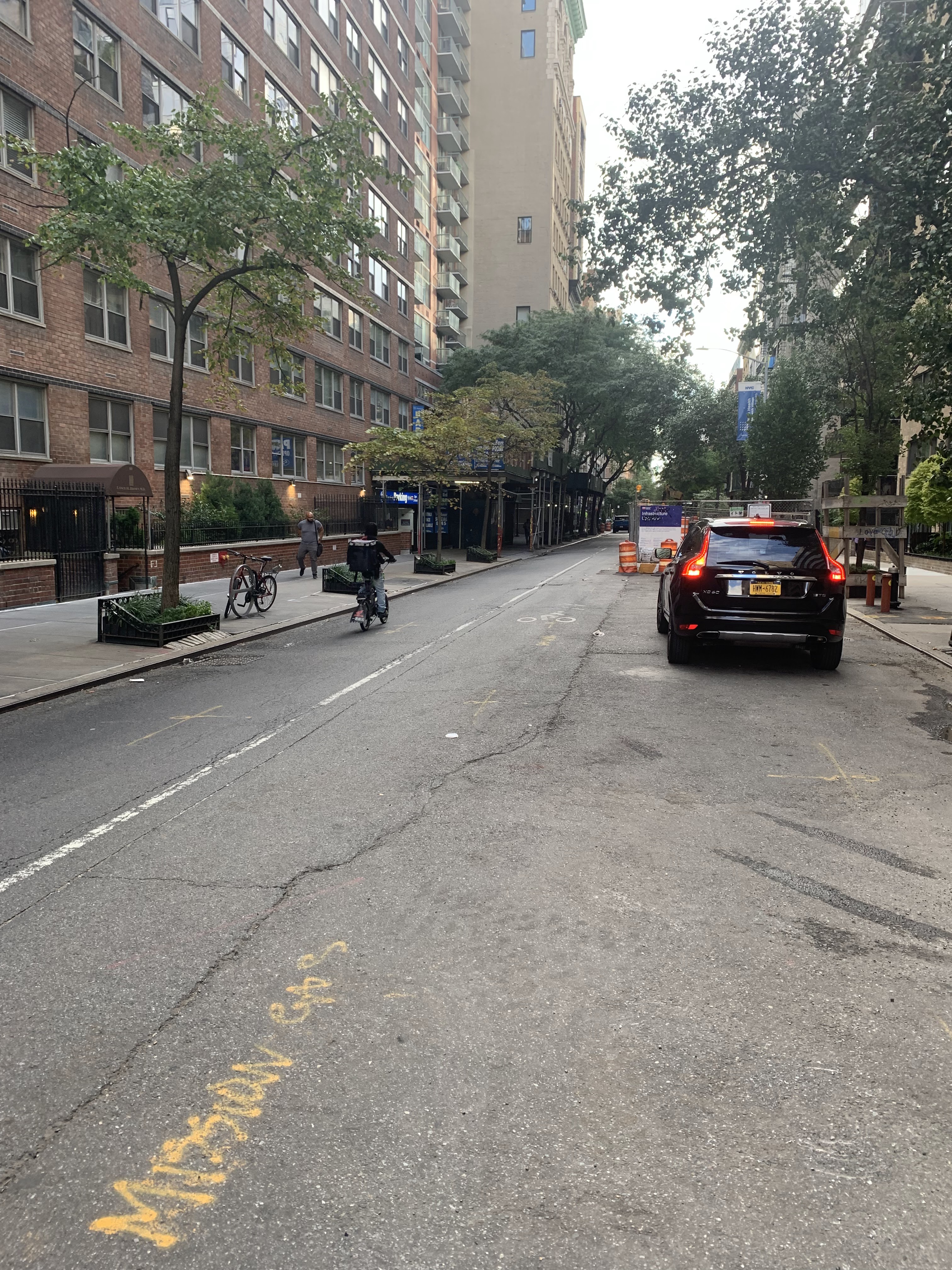
In the spring of 1938, Juliet Poyntz was staying at the American Women's Association at 353 West 57th Street in Manhattan, a low cost hotel for women. The building is still there, quite shabby and  undergoing renovations, but 84 years ago it was a very respectable place for single women. 


According to Denise Lynn (Where is Juliet Stuart Poyntz, UMass Press 2021) the only thing hotel employees saw  as unusual about Miss Poyntz was the frequency of phone calls she received from one unidentified man:

"Sometime in the spring of 1937, telephone operators at the American Woman’s Association Clubhouse at 353 West 57th Street in Manhattan began noticing that a man with a deep, German-sounding voice was calling daily for a resident named Juliet Stuart Poyntz. Poyntz was by all accounts a good resident. She was well educated, articulate, and had a background in teaching at Columbia University, where she was also working on a historical research project. She paid her rent on time and kept her room tidy. It was not particularly unusual for residents to get phone calls, but the man with the deep voice called so frequently that the clubhouse employees remembered him. Poyntz took the calls every time, so she must have known him. These daily calls did not raise any alarms, until Poyntz disappeared."

 She must have led a very isolated life by this point because no friend or acquaintance noticed that she had gone missing on June 5. According to the same source, it was the hotel manager Mr. Thackerberry who checked on her room when the rent went unpaid for several weeks:

Still, there was nothing to alert him to her unusual life—except for those daily phone calls. The telephone operators noticed that Poyntz took the calls throughout the spring and into the early summer. Then, on a hot June evening, after speaking briefly to the man, she left the clubhouse and reportedly walked in the direction of Central Park, three short blocks away. She did not return that day, or the next. After the rent went unpaid for several weeks, Thackerberry realized that something was wrong. He went to her deserted room and found an open jar of Jell-O on the desk, stale breadcrumbs on the table, and her belongings still in their places. The operators told him about the calls from the deep-voiced man and said that he had never called the clubhouse again after the June evening she had disappeared.

Thackerberry called Poyntz’s emergency contact, Marie B. MacDonald, a former co-worker and a long-time friend. MacDonald contacted Poyntz’s attorney, Elias Lieberman, also a former co-worker, and the two went to her room to look around. There was no indication that Poyntz had planned to be away from her room for long: she had left behind her passport and her citizenship papers and had not withdrawn any money from her skimpy bank account. The two contacted another friend of Poyntz’s, and together they packed up her belongings and put them into storage. They decided not to alert authorities because they knew that Poyntz was working for the underground and they did not want the police or FBI tracking her.

Seven months passed, and still no formal missing person’s report was made. MacDonald, concerned that Poyntz had failed to contact her, claimed that she had pressed Lieberman to contact the police, but he never did. Eventually, it was Thackerberry who unintentionally alerted them. After he mentioned to a police officer friend that one of his tenants had gone missing, that officer or another employee of the New York City police leaked the news to the press.

The mystery is why neither the friend whom she listed as her emergency contact nor her lawyer ever reported her missing. Were they active party members complicit in her disappearance or simply afraid for their own lives? Carlo Tresca, the longtime editor of the weekly il Martello, had no such hesitation once he learned of Poyntz' disappearance. Largely thanks to his unrelenting drumbeat of accusations, a grand jury investigated her disappearance and called the veteran anarchist as a witness. Tresca asserted, perhaps based on what she had told him, that Poyntz had been lured to Central Park by a former lover and current Comintern agent, Shachno Epstein, but no indictment was ever returned. A somewhat unreliable ex-communist named Paul Crouch accused the Stalinist executioner George Mink of being the one who lured her to her death, but there is no evidence she ever knew Mink. 

In the late 1940s many leading American communists became what could be called professional anti-communists, offering exposes of the Party's crimes to the Dies Committee (later HUAC) and to Joseph McCarthy. Among this group was Whittaker Chambers, Sidney Hook, Elizabeth Bentley and a long-ago founder of the Party, Benjamin Gitlow. He offered a very detailed take on Juliet Poyntz' disappearance. Whether it was based on insider knowledge or speculation is impossible to say. However, Peoples World, which bills itself as the successor to the Daily Worker, dismisses it as fiction:

 Poyntz was disillusioned by Stalin's purges and was unwilling to continue as an espionage agent for the USSR. Gitlow relates that the OGPU/NKVD used Poyntz's former lover, a man named Shakne Epshtein (Shachno Epstein (1881-1945)), the associate editor of the Communist Yiddish daily Morgen Freiheit (and an OGPU/NKVD agent himself), to lure Poyntz out for a walk in Central Park. "They met at Columbus Circle and proceeded to walk through Central Park...Shachno took her by the arm and led her up a side path, where a large black limousine hugged the edge of the walk ... Two men jumped out, grabbed Miss Poyntz, shoved her into the car and sped away." Gitlow relates that the assassins took Poyntz to the woods near the Roosevelt estate in Dutchess County, and killed and buried her there. "The body was covered with lime and dirt. On top were placed dead leaves and branches which the three killers trampled down with their feet."


Did the Comintern agent Epstein really meet Juliet Poyntz at this busy spot on the evening of June 5, 1937? 


Did Epstein really lead her to Central Park Drive, in 1937 a busy thoroughfare for automobiles, where she was seized and thrown into a waiting limousine?  


This scenario is certainly possible, maybe even likely, but if Gitlow had evidence of a brazen abduction and murder, why was he never called before a grand jury? In fact, why was he never indicted for concealing evidence of a crime? There are no answers at this late date, but it does seem likely that Poyntz was silenced so that she could not reveal what she had seen in Russia. And my own growing conviction is that Tresca's murder  five years later was linked to this never-solved disappearance.

"353 West 57,"  a short story based on the Juliet Poyntz mystery, was published in the journal, Drunk Monkeys, in May, 2023.


Wednesday, September 21, 2022

The still unsolved murder of Carlo Tresca


On January 11, 1943 the anarchist Carlo Tresca was shot to death on the northwest corner of 15th Street and Fifth Avenue in New York City. There was no doubt that the shooter was 33 year old Carmine Galante, known associate of Mafia boss Frank Garofalo. He was held in prison for nearly a year but never charged by the Manhattan D.A. Frank Hogan, nor was the case pursued by J. Edgar Hoover's FBI.


On July 12, 1979 Carmine Galante, who had risen over the next 36 years to head the Bonanno crime family, was shot to death by four masked gunmen in the garden of Joe & Mary's Restaurant in Brooklyn. His cigar was still in his mouth when this picture was taken.


You could say it was karma or quote Jesus, "Those who live by the sword die by the sword." Or you could point to the many killings Galante had himself ordered that same year in his takeover of the growing narcotics trade from the Gambino family. Or you could say it was the long delayed justice for his murder of one of the most courageous independent American radicals of the early 20th century. As Dorothy Gallagher titled her definitive 1983 biography of Tresca, he had "all the right enemies." In the pages of his Italian language weekly, il Martello, he had attacked Stalin, Mussolini, homegrown fascists and Kremlin stooges, the Mafia, the Catholic Church and an unending stream of capitalists and corrupt politicians. Although evidence and witnesses clearly pointed to Galante as the shooter, who had given the order to silence the 63 year old editor? And why now, when Tresca had been carrying on his unrelenting attacks for decades?


Years of controversy followed Tresca's death as one side and then another accused the communists or the fascists of ordering the murder. Both Ms. Gallagher and a second biographer, Nunzio Pernicone (Carlo Tresca; Portrait of a Rebel, 2010) agree that the most likely instigator of the murder was Frank Garofalo, a Mafia boss and frequent associate of Generoso Pope, publisher of the Italian language daily, il Progresso, whom Tresca had insulted a few months earlier. Pope's influence over the Italian vote had led FDR and Mayor LaGuardia to overlook his pro-fascist stance prior to Pearl Harbor, but that was not something Tresca would allow anyone to forget. However, the old radical had never attacked Garofalo in the pages of il Martello. 

Others pointed to the reported sighting in New York of the infamous Stalinist hit man Vittorio Vidali just before the murder. Tresca had reserved special scorn for Vidali, who was guilty of personally executing hundreds of anarchists and Trotskyists in Spain at the behest of Stalin. Tresca had an intense hatred for all Stalinists, especially since their abduction and murder of his friend Julia Poyntz in 1938. Her crime: after visiting the Soviet Union, she came away completely disillusioned. Could his continued focus on her disappearance have alarmed Stalin that winter of 1942-43 when continued US aid against the Nazis was so vital?

I returned to the neighborhood surrounding Union Square where Carlos Tresca spent most of his life, living in various apartments and moving the offices of his newspaper frequently, always low on funds, declaring the paper bankrupt more than once. I started where he was shot down, a few feet from the final location of il Martello. The building at 97 Fifth Ave has been renovated since his time and appears to be converted entirely to apartments. The 15th Street doorway through which he exited on January 11, 1943, according to Nunzio Perricone, has long since disappeared. and there is nothing to indicate the enormity of the crime once committed at this crosswalk.


Turning west, I looked down 15th Street where the getaway car carrying Carmine Galante and perhaps Frank Garofalo or the mysterious Vittorio Vidali sped away into the darkness of a city whose streetlights had been dimmed by wartime restrictions.


Retracing what I know of Carlo Tresca's life on these blocks, I came to 112 East 19th Street, an earlier home both to il Martello and to the Rand School, a longtime institution for workers run by American Socialists. No plaque identifies the history of the present building although it was here where a rightwing mob once stormed the school, only to be beaten back by workers and students.


il Martello, in the course of six moves from 1917 to 1943 occupied the same address as the Rand School once again at 7 East 15th Street. Today a Buddhist Center occupies the building, which might have pleased the old radical. Or might not, since he adhered to a very strict atheism.


Tresca moved his own quarters as frequently as he moved his office, but still never straying too far from Union Square, then and now a hub for demonstrations and activism. And a great place to meet the most interesting New Yorkers. Here is the square today:


The last stop of today's walking tour of Carlo Tresca's New York is at John's restaurant on 12th Street and Second Avenue, established in 1908. John's was a favorite gathering place for the radicals and writers of New York in the 1930s and it was here that Tresca enjoyed lunch with his old friend, the novelist John Dos Passos, only hours before he was killed. Perhaps they talked of Dos Passos' journey to Spain with Ernest Hemingway and his deep disillusion with the Stalinist destruction of the anarchist and socialist opposition to Franco's fascism. Dos Passos might perhaps have remembered how Carlo had warned him to beware the murderous NKVD agents sent by Stalin to wipe out any leftists who would not bow to Moscow. Or perhaps they discussed a rumor that one of those same homicidal agents, Vittorio Vidali, had left Mexico after arranging the murder of Leon Trotsky? And was possibly sighted in New York?


This coming January will mark the 80th anniversary of the still unsolved murder of Carlo Tresca. He has already appeared twice in my own works. He first appeared in The Red Nurse (2012, Amazon) as a brilliant organizer and onetime lover of Helen Schloss during the 1912 Little Falls Textile Strike. His second appearance was as mentor to the young radical Tom Ryan in The Witch Girl & The Wobbly, a novella published last year. ( Running Wild Novella Anthology, Volume 4 Book 1: Wright, Peter: 9781947041820: Amazon.com: Books) 

The next appearance of Carlo Tresca is a work in progress.


Sunday, January 24, 2021

"The Witch Girl and The Wobbly" published by Running Wild Press


 My novella set among the isolated people of the Taconic Hills a century ago has been published in Kindle and paperback editions: 

Running Wild Novella Anthology, Volume 4 Book 1: Wright, Peter: 9781947041820: Amazon.com: Books

The story is narrated by Tom Ryan, a young man radicalized by the 1912 textile strike in Little Falls who comes to New York City in flight from World War I conscription. Falling in with the anarchist firebrand Carlo Tresca and the future Communist Party leader Elizabeth Gurley Flynn, he is recruited to organize workers in upstate Stottville. Fleeing a bogus murder charge only days after he arrives,  Tom finds refuge in the long isolated community known to local historians as the Taghanic Basketmakers or Pondshiners.

The story takes a turn when Tom meets a daughter of that community, only recently ravaged by the misnamed Spanish Flu pandemic of 1917-19. An excerpt from that encounter follows:


I hardly remember stumbling into a lake and then climbing up a hillside full of trees and after that I must have passed out. I saw a girl with a bow and arrow, and thought I was dreaming.

I have no clear recollection until the next day. I was under a rough blanket and could hear the sound of birds. Opening my eyes, I saw that I was in a room with walls that looked to be made of mud and sticks. The iron pots hanging from the walls looked about a hundred years old. Then I noticed a little girl, no more than seven or eight, in a raggedy dress. She jumped up in a fright when she saw I was awake and ran out through the canvas flap that served as a door. A minute the later the older girl, who might have been sixteen, the one I had seen in the forest, poked her head into the room and said something in a blurry sort of voice. “I'm sorry,” I said. “What did you say?”

She came a few feet farther into the hut. I could see that the smaller girl held her hand and was trying to pull her  back out of sight. “Are you still feelin' peaked?” she repeated.

“No, I'm all right, thank you.” 

The two girls so closely resembled each other that I was sure they were sisters, although the older was dark as a Sicilian and the younger light as a Dutch girl. With her long, straight black hair, the older one reminded me of a picture of  Pocahontas I'd seen in a schoolbook.

    When she didn't reply, I added, “Thank you for taking care of me. I guess I was pretty sick when you found me.”

    The older girl nodded. “You hungry now?”

   “Sure,” I told her, and she vanished. A few minutes later she came back and handed me a wooden bowl. I tried a mouthful of a kind of stew, which was about the gamiest stuff I'd ever tasted, but I was so hungry I took another spoonful. “Pretty good,” I lied. “What's in it?”

    “That there's some fine squirrel meat and healing roots I gathered special.” She relaxed enough to sit down on a wooden stool. “That'll bring ye back to yourself.”

   “Well, I thank you for it,” I said, forcing myself to keep eating. “You've been very kind.”

    She blushed at that, and put her face down. Wanting to keep her talking, I asked her, “Did I really see you with a bow and arrow or was I dreaming?”

    That brought a shy smile to her face, but she quickly looked away. “I'm the best hand at a bow of any woman on the hill,” she said in a very serious voice. “I took down that squirrel you're eatin' this very morn.”

   “Of any woman? Are there other women who use a bow and arrow?” 

I was wondering if I had stumbled into Sherwood Forest and she was Maid Marian.

    “Them's our ways up here, not that I 'spect you to know that. We gals are the only ones 'lowed to touch a bow and it's on us to catch squirrels for the pot. Or bunnies if we see one. A'course, it's only the men 'lowed to take down deers 'cause they have their guns but there's never any deers, not for years, anyways.”

    As I was trying to figure this all out, she asked me “How come you's meandering on the hill, anyways? You from the hotel?”

     “Hotel?”

    “From the hotel down on Lake Charlotte. Lots of city folk been comin' there of late and it'd not be strange if you'd got yourself lost in the woods.” 

     “No, I don't know about any hotel. I was just...”

     “Then there's no place you got to be goin' in a hurry?”

    “No, for a fact, there isn't.”

    “Good, that's good.” She stood up. “Ye needs to rest now. If ye need a thing, call out and my lil sis'll get it for ye. Her name's Mary.”


To read the entire story and those of my fellow novella writers, order the book by clicking on the link at the top of this page.


Thursday, November 5, 2015

The Lost People of the Taghanic Hills


“TheWitch-Girl and The Wobbly” is inspired by the legends of a people known as Pondshiners or Bushwhackers who lived in isolation for many generations in the wooded hills surrounding what is now called Lake Taghanic. They kept to themselves, growing a few crops in the rocky mountain hollows, working from time to time for nearby farmers, and producing for sale a beautiful and unique kind of basket which is now highly prized by collectors. (Published in 2021 Running Wild Press Novella Anthology)


The Pondshiner community was located
 in what is now Lake Taghanic State Park


The Taghanic basketmakers were similar in some ways to other isolate cultures such as the Eagles Nesters near Kingston, the Sloughters of Schoharie and the better-known Melungeons of the southern Appalachins, all of whose origins are shrouded in myth. When the Taghanic people came to public attention through a series of sensationalized articles by Frederic Van de Water in the 1920s, no one knew how long they had lived apart from the surrounding culture. Perhaps they had fled oppressive landlords during the anti-rent wars of the 1840s. Perhaps, as Van de Water thought, they had been up on “the Hill” for centuries. Some traced their skill at basketry to Mohican influences.


What is clear is that their small society was devastated by the influenza epidemic of 1919, when this tale is set. The narrator, Tom Ryan, was a boy during the Little Falls Textile Strike of 1913 and dreams of an activist life as a “wobbly,” as members of the International Workers of the World were called. Arriving in New York City just as the war is ending, he pays little heed to the flu epidemic and is more directly affected by the Red Scare which targeted the radicals, like Carlo Tresca and Elizabeth Gurley Flynn, whom he idolizes. Accepting a job with a new union, he arrives in Stottville, determined to organize the Julliard mills. Things go badly and in his flight from arrest, Tom stumbles into the forest world of the Pondshiners.

Old Yet and Mattie Hotaling, 
from Carl Carmer's "Great River of the Mountains"

Those who prefer their history straight may take exception to my depiction of what might be called wiccan beliefs among the Pondshiners. However, I believe there is ample evidence for a persistent belief in magic and witches in this isolate culture. Carl Carmer in his 1939 book, The Hudson, devotes a chapter entitled "Witches Make Star Tracks" to the supernatural beliefs of the Pondshiners and similar Hudsom Valley groups. According to him, a belief in witches, and fear of their powers, was universal among the Pondshiners. Crosswell Bowen in his 1941 photographic study, Great River of the Mountains, said that “Most of them cannot read but they tell strange stories which echo of the middle ages” and “their world is peopled with goblins and spooks and omens.”


Considering the frenzy of witch-hunting on the other side of the Berkshire Hills in the 1600s, it is conceivable that a few believers in the old ways might have fled to safety beyond the reach of the Puritan inquisitors. And perhaps a young radical might fall in love in 1919 with a girl who shared those ancient beliefs, and who possessed powers which his materialist philosophy could not explain.

An except from “The Witch-Girl and the Wobbly”

“It's when the Goddess fill your heart and show you the right path to take.”
“The Goddess?”
“Mama tol' me all about Her.” She looked anxious for a moment. “She said I was never to tell anyone from outside the Hill but I guess it's all right telling you 'cause we're...”
“Because we're in love.” I touched her face and she nodded.
“Mama said that the bad Bible folk called anybody with the light from the Goddess was witches.” She kept looking into the forest as she spoke. “That's why they hanged the mama of the first Brother and Sister and they had to run away and live up here on the Hill with the Red People. And Mama said that the gals in our family could always get a light from the Goddess when things are real dark.”
“Like now?”
“Yea, like now.” She looked troubled. “Only I don't have no light now.”
“I think it will come to you, Lizbeth, and you'll know the right path to take.”
“Do you think so?”
“Yes, I do. But that path might have to take you away from this Hill.”


"The Witch Girl and The Wobbly" is available on Kindle for 99 cents.
 and is in paperback  as "the Lost People" in the collection, A Good Catholic Girl and other Tales.