Tuesday, June 18, 2013

You Don't Need a Weatherman


You don’t need a weatherman to know which way the wind is blowing.
                                                     -Bob Dylan


It’s getting hotter.  But here in our corner of the upper Hudson Valley, it really doesn’t seem that bad this year. The apple crop has not been destroyed by erratic  heat waves and frosts, as it was last year, and the harvest promises to be especially good. The Mohawk and the Schoharie have been running high and boat traffic did have to be suspended last month on the Erie Canal but so far there’s been nothing quite as bad as the huge floods that followed Hurricane Irene in 2011.  And the tornado that ripped through Rotterdam and Schenectady a couple weeks ago may have been an anomaly, though some Assemblymen are worried by increasing tornado activity in the state and have called for an improved public warning system.

We all know that it’s a lot worse this year elsewhere in America.  Waves of tornados have crashed into Oklahoma. Wildfires are out of control in Colorado. Not that we’re immune around here. Last October Superstorm Sandy swept out of the warmest ocean temperatures ever recorded off our coasts to cause the kind of damage none of us imagined possible.
 
But the mass media tell us that we’re rebuilding. Republican Chris Christie and Democrat Barack Obama toured the Jersey shore last month in a heartening display of bipartisanship.  One reporter did nag the governor about whether New Jersey should have prepared for the future with climate change in mind. “No,” said Mr. Christie, “cause I don’t think there’s been any proof thus far that Sandy was caused by climate change.” President Obama, who from time to time admits that the climate is changing, stood next to him on the boardwalk but did not express any embarrassing disagreement with his host.


People want to be positive. “The storm can’t beat us,” as more than one New Yorker has said. Thus far,  I haven’t heard anyone say, “We’re New Yorkers and we’re a  lot tougher than carbon dioxide” but it seems many of us might feel that way. If not, why would people be buying up Rockaway beach front like crazy, barely eight months after nearby Breezy Point was obliterated?  True, they won’t be getting the same deals on federal flood insurance but these frantic buyers don’t seem that worried.


People who take the long view, of course, like insurance companies and farmers can’t afford to deny what’s right in front of their eyes. New York City Mayor Bloomberg, as a prime example, is not one to underestimate risks or he would never have become the billionaire that he is.  On June 11 he called for a $20 billion investment in flood barriers to protect New York City from whatever comes roaring out of the Atlantic in coming years. He quoted environmental scientists who predict sea levels rising as much as 31 inches by 2050, accompanied by severe storms and prolonged spells of extreme heat and cold But Mayor Bloomberg is leaving office this year and the odds against building such barriers may be as great as those against the gun control laws he’s also been fighting for. 


We’re nearing a point where not even the most avid denialists, like Texas Governor Rick Perry or Oklahoma Senator James Inhofe, will be able to keep saying that everything is just fine and dandy, just the way God always wanted to be. (After all, 2012 was the hottest ever recorded in this country.)

Those who want to do nothing, however, will keep questioning why it’s all happening. They will be at great pains to point out that no one event, no matter how horrific, can be linked to a changing climate. And my guess is that they will keep expressing such doubts and keep advocating the burning of fossil fuel, no matter what the evidence.

The question the doubters and denialists won't want us to ponder is:  Do the droughts, tornadoes, heat waves, wild fires and floods have anything at all to do with how much carbon dioxide our cars, our air conditioners, our furnaces, our airplanes, our use of electricity sends into the atmosphere?
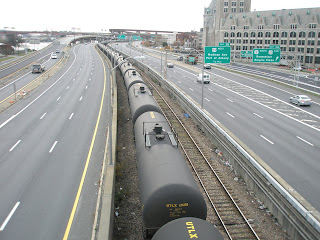


 And since we don’t agree on whether we ourselves are responsible, trains full of  Dakota crude oil still come through Albany every day for the past year as if burning all that fuel will have no effect on the rising temperature of the globe. Governor Cuomo, who was so forthright about the reality of climate change right after Superstorm Sandy, has not commented on all those tanker cars lined up along I-787. (Click on image for earlier story on this)

The national government still sends its fleets and armies across the planet as if obscure tribesmen and angry fanatics were anything but a minor threat when compared against devastating climate change. The federal legislature is still dead-locked  over abstract financial numbers as if Washington itself may not be covered by the sea before they ever reach an agreement. And as each region of the country faces the impact of forces the federal government chooses to ignore, who is to say what the future will bring?

To answer this question is to enter the realm of fiction, or science fiction. And that is what led to my latest story, now available on Kindle for 99 cents - Just click on the cover image at the top or bottom of this post.

Imagine a retired couple enjoying their golden years in a time after New York, Boston and Washington have vanished beneath rising seas. Imagine a time of rainy and dry seasons, of wildfires that take out entire states, and of powerful regional regimes that have assumed the power that an obsolete and archaic national government refused to wield.


How would such confederations of the old states survive in an era when the climate causes repeated waves of destruction? A time when no more oil can be imported?  Would such a confederation of northeastern states turn to back to coal? Would steam-driven locomotives become the most reliable means of transportation in such a time? Would the leaders of such a society still be denying that burning fossil fuel is making the planet ever hotter and more threatening to human survival?


Now, imagine that the grandson of this elderly couple is a weatherman for WMHT radio in a time when television and the internet are distant memories. Now that the satellites are gone, young Ray’s respect for old-school methods wins him a devoted following in the regional capital at Albany.


Then, one rainy Monday Ray takes to the air waves to become the most dangerous kind of whistle-blower any society can imagine: the man who claims that everything that has gone wrong with the world is our own fault.


Excerpt from the opening of You Don’t Need a Weatherman:


We used to plant tomatoes, cucumbers, zucchini, corn, you name it, but with all the rain we’ve been having lately, we finally switched to damp-resistant potatoes and turnips. Marge and I both like to putter around in the garden so when the rain finally tapered off on Monday, we went out to pull a few weeds. I ran an extension cord so we could bring the radio with us and catch the noon weather report. 


To be honest, we just like to hear Ray’s voice. He always starts out saying “Stay tuned for the official North East Regional Authority ten day weather forecast.” Then he reads a commercial, say, for a special railroad excursion to Whiteface Mountain. After that, he might read another commercial for canning jars or mosquito netting. And then he reads the forecast. There was nothing unexpected in what Ray read on Monday.  Just rain today and tomorrow, followed by partly rainy, cloudy, more cloudy, more rain and a flood warning for the end of the week. 


Unlike a lot of those guys who pass for weathermen on the radio, Ray has a double degree in meteorology and geology from Union Siena and really knows what he’s talking about. The Weather Bureau experts at NERA even consult with him on some of the trickier predictions. Of course, there’s no sure way to foretell the weather that isn’t tricky, unlike years ago when the satellites were still up. You might say it’s all guesswork now although Ray would disagree. He’s a great one for checking wind speed, barometric pressure and all that, and he even talks on the telephone with weather men in the Central and Southern Regional Authorities. He told me that he got in some trouble for that once, around the time of those border incidents in Kentucky.


And did I mention that Ray Rogers, the weatherman at WMHT Schenectady, is our very own grandson?


 Ray’s feature program is our favorite, a fifteen minute slot billed as “Ray’s Rainy Day” broadcast every Monday and Wednesday from 2:15 to 2:30.  His angle is to tell uplifting weather stories, like the little girl who survived for a month in a collapsed building after the Great Boston Tornado or the boy who warned his village when Superstorm Sammy surged all the way to Harpers Ferry. 


Unfortunately, we both dozed off after lunch and missed the show. Marge says that retirement can make you really lazy.


We went over that evening to play cards with the Feldmans.  Bob retired from NERA Rail the same time I did and has been a pal for years. As she dealt the first hand, his wife Jane relayed some gossip about dead bodies floating in the Estuary that she heard from Mary Hotaling, whose brother is a Hudson Riverwatcher
.

“Makes me think of the time you and me were working the Scranton Line,” observed Bob.


“Do you mean when the Chesapeake Bay moved way up into the Susquehanna?”


“Yeah, all the bridges had been wiped out and there were bodies floating everywhere.”


“Funny, we came through a year later and the Susquehanna was bone dry.”


“That was the summer of the big wildfires, wasn’t it?”


“It was a son of a bitch getting the coal train through that mess, wasn’t it?” Looking at my pair of fives and three queens, I winked at Marge and said, “I call.”


“We nearly choked to death,” laughed Bob, laying down his aces and tens. “Full house!”


“What a bastard!” I was laughing along with Bob. We don’t play for serious money, just fun. 


Shuffling the cards, I started to deal. “That fire was no joke. It burned out most of Maryland before the hurricanes came.”


“You remember those walls of fire on both sides of the tracks in Hagerstown? A couple of boxcars burst into flames before we could disconnect them.”


“Hagerstown? Don’t you mean New Washington?”


“I keep forgetting they’d moved the federal government up there before they went to Charlottesville.”


“Ever since old D.C. was engulfed, the Feds keep looking for a perfect spot for the new capital.”


“I don’t know why they even bother to keep it all going, the President, Congress, Supreme Court, that whole circus. It isn’t like they have any serious work to do since the Regional Authorities stepped up.”


“The USA is an important symbol, like the flag,” I reminded Bob. “It stands for our freedom.”


Read the rest of You Don't Need a Weatherman on your Kindle reader for 99 cents. The Kindle version can  also be read on tablets, smartphones and PCs by downloading the free Kindle app. Amazon Prime members may borrow the story through the Kindle Owners Lending Library. Click on cover image for details.

Wednesday, June 12, 2013

New biography of Alfred Dolge


 The  Violet Festival in Dolgeville last weekend was once again a celebration of the wonderful spirit of the village founded by Alfred Dolge so many years ago. Here are some scenes and the script of  the annual living street theater production on the life of Alfred Dolge. 


My new short biography of Alfred Dolge is now available on Kindle for 99 cents and as an illustrated paperback for $7.95. The Kindle version can  also be read on tablets,smartphones and PCs by downloading the free Kindle app. Amazon Prime members may also borrow the story through the Kindle Owners Lending Library.

This booklet is meant only as an introduction to the remarkable founder of Dolgeville and originator of an early form of Social Security. I draw  on two works that are essential to anyone interested in the history of the Dolgeville and Little Falls. Dolge by Eleanor Franz is the only full length biography of  Dolge ever published and can be purchased from the Herkimer County Historical Society. Richard Buckley's history of Little Falls, Unique Place, Diverse People can be purchased from the Little Falls Historical Society.

 Dolge himself wrote widely and two collections of his thoughts can be found on google books: The Just Distribution of Earnings, So-called Profit Sharing (1889) and The Practical Application of Economic Theories in the Factories of Alfred Dolge & Son (1895)

I also found the Dolgeville-Manheim Historical Society to be a great source of material on Dolge and his era. Dolge's self-published History of a Crime can be purchased in photocopy form at the Society's museum on Main Street in Dolgeville.

In the new Alfred Dolge my goal is to increase awareness of a visionary businessman whose great experiment is more relevant than ever, a hundred and fifteen years after his enemies forced him into bankruptcy and destroyed the amazingly equitable and prosperous industrial village he had created. The Social Security System, now under attack from a variety of politicians and their wealthy backers, gives credit to Dolge as one of its forerunners. But his downfall is particularly instructive at this time.

Dolge was a captain of industry, an immigrant who made his fortune in America, and completely devoted to the capitalist system that made him and his family so wealthy. And he did not stint from enjoying that wealth, living in a grand mansion attended by servants, traveling annually to Europe, and throwing his son an over-the-top wedding in which the happy couple and guests came from New York to Dolgeville on their own special wedding train.

But Dolge understood that unrestrained capitalism could not last.  Analyzing the recession of 1892 for his fellow Mohawk Valley industrialists, he pointed to the collapse of demand as the real cause of the fiancial crisis: “Capitalists must learn that wage earners of today are of greater importance to the community as consumers than as producers.”  He saw the labor conflicts that were growing in intensity from the 1870s onward as due not to dangerous radicals but to the reasonable demand of workers for a better life: “Almost every conflict between capital and labor originates in the demand of laborers for a betterment of their condition.” 

He said that too many manufacturers subscribed to the notion that “profits rise as wages fall,” and argued that the recession of 1892 was due to a collapse in demand caused by the failure of Congress to pass a protective tariff that would safeguard high wages for workers.  His insistence that American industry and workers had to be protected from low-wage competition overseas was self-evident to him and to many of his fellow Republicans in those years - a stark contrast to the present time in which both parties vie to see who can do more to outsource American jobs and dismantle american industgry, all in the name of "globalization."

When Dolge spoke to his fellow capitalists, he presented his social and economic reforms as simply enlightened self-interest. But his commitment to building a prosperous and cultured life for working people went deeper and was rooted in the example of his revolutionary father and in his readings of such diverse authors as Karl Marx, Adam Smith and David Ricardo. Wilhelm Leibknecht, found of the German Socialist Party, was a close friend of his father and a guide to Albert's youthful studies of politics and economics. 

Eleanor Franz described the breadth of Dolge's vision:

“What Dolge built grew out of his determination that children should no longer scavenge coal, or old men end up in paupers’ graves. It was his belief that a workman should be able to retire at sixty with a pension paid for by his employer as part of the cost of production. The security of such a plan, he wrote, “would allow the laborer to live better and be more healthy, keep his wife at home and his children in school. He could live up to his income and thus develop a higher manhood and superior citizenship.” Dolge saw employees eventually becoming partners in a business, so that a capitalist would no longer be enriched at the expense of his laborers. Even though he believed in hard work as a way out of poverty, it was never his belief that the poor remained poor because of laziness. What he aimed for was, in effect, a leveling of the economy to benefit everyone rather than solely the man at the top.” 

Some who have studied his life may differ but my view is that Dolge was brought down by a conspiracy among his fellow capitalists, led by George Hardin and Schuyler Ingham but supported by other wealthy men afraid that the high wages and social benefits Dolge provided to his workers would lead their own employees to demand the same and thus cut into their own immense profits.  The resentment of Dolge took on a very personal note, as when Hardin told the Little Falls Journal & Courier in 1898 that Dolge was "an anarchist, an atheist and a communist." 

The life of Alfred Dolge has much to teach about the struggles of our own time and we can only hope that people beyond Dolgeville will be inspired by his dedication to building a humane capitalism in which working people can thrive.


Previous posts from this site on Alfred Dolge and Dolgeville: 


Thursday, May 30, 2013

The Real Twentieth Hijacker

http://www.amazon.com/dp/B00D3PZAEA


My latest work focuses on a much more recent era in New York's history, the tragic days when our leading city was attacked by fanatics consumed with hatred. On September 11, 2001 nearly three thousand human beings were murdered by four small groups of men.  Three of the attacks were carried out by five man teams and succeeded in causing untold suffering. The fourth consisted of four men and that was the only team that failed. The fact that only one attack failed was due to the bravery of the Flight 93 passengers who fought back but the failure may also have been affected by the absence of a fifth man. By September 12, 2001 investigators were asking: where was the missing terrorist?

In 2003 a Moroccan named Zacarias Moussaoui, who evidently had severe mental problems, was convicted of being that missing twentieth terrorist and sentenced to life in a maximum security prison. He acted as his own lawyer, rambling on incoherently and making little sense before finally offering the confession that earned him a life sentence. At the time, and since, those who have studied the case have expressed serious doubts as to the role Moussaoui played in the events of 9-11.

In "The Real Twentieth Hijacker" I offer an alternative candidate for this dubious role: a young Algerian immigrant, a student at LaGuardia Community College in Queens who is recruited for flight training by a man he meets in a cafe on Steinway Street. This young man, Mohammad Mostaganem, believes he is following the instructions of Osama Bin Laden when he enrolls in a flight school in South Carolina.

But something changes. Something diverts Mohammad from the fatal path he has taken. Not the intervention of the FBI or the CIA. Not a drone attack nor a targeted assassination. 

Mohammad falls in love.


The story is available via Kindle for $.99 and may be read on tablets,smartphones and PCs by downloading the free Kindle app. Amazon Prime members may also borrow the story through the Kindle Owners Lending Library.


Excerpt from "The Twentieth Hijacker"


 “Remember that when Allah closes one door, he always opens another.”
“So it has been said.”
“I have learned of a glorious opportunity for the right man.”
“Yes?”
“I have spoken with a messenger who comes from the Sheik. ” Ashrawi’s voice took on a solemn tone. To Mohammad he sounded like a revered scholar reading from the Hadith.
“Peace be upon him!”  They had spoken of the Sheik on many occasions, but always as of a legendary figure, almost as if he were the hidden Imam or Saladin.
“The  Sheik, Osama?” asked Mohammad. “He who led the Mujaheddin to victory over the communist atheists?”
“Yes, Osama bin Laden.”
Ashrawi paused, as if to let the great name sink in.
“He is preparing a powerful blow against the infidels.”  The Egyptian stopped talking while an old man passed by, walking his dog. Then he continued. “He seeks men who will give their lives to Allah.”
Ashrawi put his hands on Mohammad’s shoulders. “Are you such a man?”
“I am.” Mohammad’s heart beat fast. “What does the Sheik require of me? I am prepared for whatever he will ask.”
“The first thing that he asks,” smiled Ashrawi, “is patience.”
“Of course. I can be very patient.”
“Good. We will talk again, in another place.”
A week later, they met on the great plaza in front of the World Trade Center. “Let’s go across the street,” suggested Ashrawi. “It is very quiet in the cemetery of the old church.”
Sitting on a bench in the churchyard of St. Paul’s Chapel, the two men spoke in low voices.  “You are a smart guy, Mohammad,” Ashrawi began. “You can learn many things, true?”
“Yes, praise be to Allah, I believe that you speak the truth.”
“Even though you are here only one year, your English is better than mine, true?”
“Yes, thanks be to Allah.”
“Do you think that you could learn to fly an airplane?”
“If someone will teach me, I can learn.”
“Good. Very good.”
“But why must I learn such a skill?”
Ashrawi did not answer directly. “My brother and I were very impressed by how well you did with the cigarette business,” he told Mohammad. “You learned how to move around this country without attracting the attention of the police. Some of our Arab brothers can’t take the subway three stops without the police getting suspicious.” He laughed and lit a cigarette. “But you drive your car better than the Americans drive. And no cops ever stop you, even in the southern states where they hate all dark-skinned people.”
“True,” admitted Mohammad. “I stay right below the speed limit, not too fast and not too slow.”
“One other thing we saw about you, my brother. You can work alone. This is very important. Many of our most dedicated brothers could not spend days or weeks apart from other true believers.” Ashrawi paused. “The Sheik believes that you are the right man for a most important task. “
“You have spoken of me to the Sheik?” Mohammad was awed.
“Of course,” said Ashrawi. “He is the one who must make all of the great decisions. He is the one who must select the true warriors for Allah.”
“I am grateful.”
The Egyptian continued. “The Sheik thinks that you could learn how to fly the airplane that we need for this new mission.”
“Please,” said Mohammad, “let me know what I must do.”
Ashrawi stood up and took off his jacket. Mohammad realized that he was making sure there was no one watching them. The cemetery was empty.  “Praise Allah, the Sheik has decided that you should go to one of the American schools for flying airplanes.”
Mohammad nodded. He began to see the outlines of a plot. They would capture a plane and trade hostages for the brave fighters imprisoned by the Israelis. He would be the pilot of this hijacked plane. Perhaps they could even force the Israelis to retreat from the West Bank.
“Since you know the states of the South, the Sheik has decided to send you to a flying school in Myrtle Beach in the state of South Carolina. Do you know the Myrtle Beach?”
“Yes, it is a place where infidel women go to bare their bodies beside the ocean.”
“You will go there and enroll in a flying school and complete the course. The Americans make it very simple. You can apply to the school for fifty dollars. Go to the public library and do the application on the internet and then get a money order for the application fee.”
“Is it so easy to go to a school for flying?”
“Very easy, because it is a big money business. Americans sell their own sisters for money, no?”
“This is true.” Mohammad laughed.
“The tuition for nine months is twenty-five thousand dollars.” Ashrawi took a large manila envelope from his coat. “Here is thirty thousand dollars in cash. Use it to pay the tuition, and find someplace to live while you are taking the flying lessons.  A cheap motel, not one that the school recommends. That way you do not have to make unnecessary conversations with the infidels
Mohammad held the envelope in his hands. The money made it heavy.
“Here is a new cell phone.” Ashrawi added. “ I will call you only on this. You will use only this phone to call me. There is one number programmed into it. That is the only way you will reach me, you understand?”
The two men embraced. Tears were in Mohammad’s eyes. Ashrawi walked away quickly, going past the ancient, tilting gravestones and disappearing into the crowds of lower Manhattan.


Saturday, February 9, 2013

New edition of Judge Benton's 1856 History of Herkimer County


A new edition of Judge Nathaniel Benton’s 1856  A History of Herkimer County is now available for free download as a PDF and in a non-profit paperback edition at $5.45. Both versions are available at Wilderness Hill Books and are intended for students of local history.

 The new edition contains the historical narratives of the Colonial and Revolutionary period but omits sections on the European history of the Palatine Germans, family histories and later events. 

Those interested in consulting the complete book can find it on this link at Google Books.  Chapter VIII will be of interest to genealogists and includes sketches of some of the main Palatine families such as the Bellingers,Caslers, Helmers, Herkimers, Dockstadters, Bowmans and Folts. Chapters IX and X cover historical and local political events from 1791 down to 1855.

In the seven chapters of the Wilderness Hill edition, Judge Benton  traces the arrival of the Palatine Germans in the early 1720’s through the growing storm of the Revolution in the 1770’s and concludes with the aftereffects of that bloody struggle. He  himself was a major political figure in the county during the first half of the 19th century but does not draw on his experience at all in this book. Born in New Hampshire, he served in the U.S. Army during the War of 1812, where he rose to adjutant general and presided over two courts martial. He came to Little Falls in 1816 to study law under George Feeter, and served as county surrogate judge, U.S. Attorney for the northern district, New York State Senator from 1828-1831, and Secretary of State of New York from 1845 to 1847. In his later years he devoted himself to composing his history of Herkimer County, drawing on old records and the memories of the few who still survived from the early years of the republic, or their children.

 
The author shares relatively few of the racial and gender prejudices of his own time, and his book is a reliable source for many otherwise unrecorded incidents from the colonial and Revolutionary eras. His observations on Iroquois culture, for example, are quite candid on the freedoms enjoyed by Iroquois women in contrast to the second class citizenship of American women of his own era:

 
"Another peculiarity marked these people. The matrons of the tribe, in council, could always propose a cessation of hostilities, and this could be done without compromising the warriors and chiefs. For this purpose a male functionary, the messenger of the matrons, who was a good speaker, was designated to perform an office which was deemed unsuitable to the female. When the proposition to drop the war club was resolved upon, the message was delivered to this officer, and he was bound to enforce it with all the powers of eloquence he possessed.
    Marriage among the Iroquois was a mere personal agreement between the parties, requiring no particular sanction and in no respect affected the rights of property, if the wife had any. Whatever goods, effects or valuables of any kind the wife had before marriage, she continued to hold absolutely, and if a separation took place, the wife was entitled to take with her all her property."

 
It is the Palatine Germans who most concern Benton and he goes to some length describing the many legal and political difficulties which these pioneers faced in attempting to escape from indentured servitude in the Hudson Valley and gaining their own land in the Schoharie and Mohawk Rivers in the 1720s. And he is very compassionate in describing their hard lives and the violent attacks they experienced, first from the French in 1757-1758, and from the British and their allies during the Revolution.
 
The Oriskany Battlefield
 
 
Although he admired Nicholas Herkimer, Judge Benton’s description of the subsequent battle of Oriskany in 1777 acknowledges that the general’s decisions cost the lives of hundreds of local militiamen who followed him:
 
 
"All previous accounts had fixed St. Leger's forces at 2000 strong, nearly half of which were Indians led by Brant, a brave, active and artful Mohawk sachem. Herkimer knew this, and he no doubt believed, as well he might, that a force superior to his own, could be sent against him, which would select its own battlefield, without in any way interfering with the investment of the fort. But noisy insubordination prevailed, and precipitated the little band of patriots into the jaws of death. Smarting under the repeated accusations heaped upon him, and irritated no doubt, the General gave orders to take up the line of march, which was received with cheers by the men, who proceeded rapidly on their way, two deep, having thrown out the usual advanced and flanking parties.
     At 10 o'clock, on the 6th, the main body of troops passed over a causeway on a marshy ravine, the advance having commenced an ascent of the westerly slope, when a well directed fire from the enemy, in front and on both flanks, accompanied with the dismal Indian war-whoop, unfolded to the American general that his division had become involved in an almost inextricable ambuscade. Retreat was impossible, for the causeway over the marsh was already blocked up with teams; and the rear guard, just commencing the descent of the eastern declivity, commanded by one of the officers who in the morning had taunted his general with cowardice, turned a fled on the first fire of the enemy. But light did not save them from the fate that awaited their comrades on the west side of the ravine; the enemy, knowing well the ground, had gained the rear, and shot down the fugitives as they ran away from their companions. As might well be expected, the suddenness of the attack and the intensity of the enemy's ire, not only produced great disorder among the provincials, but annihilation seemed almost inevitable for a time.
 Hanyost Schuyler's mother pleads
with Benedict Arnold
(from 1877 Harpers Magazine)
 
Annihilation was averted, although losses were very high among the militia force of about a thousand. According to Benton, American reports listed 200 dead while British listed 400 Americans dead and 200 captured. The British only retreated from Fort Stanwix due to a clever ruse perpetrated on them by Herkimer's nephew, Hanyost Schuyler, popularly thought to be a madman:
 

"Hanyost Schuyler was the instrument made use of to scatter the besieging forces surrounding Fort Schuyler, and send them helter-skelter back to Canada in double quick time. The home of this strange and singular being, was near the upper Mohawk Indian castle in the present town of Danube, where he resided with his mother and brother Nicholas, and hence in early life had much intercourse with the Indians. He is described as coarse and ignorant, and but little removed from idiocy, and still possessing shrewdness enough to be made the instrument of accomplishing an important object. Hanyost was somewhat tainted with loyalty, and had been captured at Shoemaker's with Walter N. Butler, and others' he was tried by a court martial and sentenced to death. Hi mother and brother, on hearing this sad new, of course hastened to headquarters to intercede for his life. For a time their efforts were unavailing, but finally it was proposed he should repair to St. Leger's camp with a friendly Oneida Indian, and so manage to alarm the enemy as to produce an abandonment of the siege.

     Hanyost gladly embraced the alternative, leaving his brother as a hostage for the faithful execution of his mission; being assured that Nicholas should die if he faltered in the enterprise. Schuyler having procured sundry shots through his garments, that he might show he had run for dear life, departed with his Indian comrade for the enemy's camp. They had arranged between them to approach St. Leger's position from opposite directions, and were not to appear acquainted with each other, if they should meet. This affair was wisely planned, and most skillfully and adroitly executed. The instrument was well chosen. He was well known as a loyalist, and the parties to whom he first addressed himself were no unwilling auditors, no in an unfavorable mood to be deeply impressed and even awed by his ambiguous language and mysterious manner. The native American Indians, like the followers of Mahomet, were ever inspired with a peculiar respect and even reverence for idiots and lunatics. Fraternal regard strongly prompted Hanyost to apply all his energies and to leave no effort untried to secure the complete success of his mission, and relieve his brother from the fate that was hanging over him. He was completely successful, and having followed the retreating enemy to Wood Creek, he there left them, and returned to Fort Schuyler the same evening, and gave Col. Gansevoort the first intimation of Arnold's approach. It was not until Schuyler's arrival at the fort, that its commandant was able to solve the problem of St. Leger's sudden departure and precipitate flight."
 
 
I do not share the Judge’s estimation of Hanyost and made him the protagonist of my novel, Neither Rebel Nor Tory, which includes much of the same history included in Benton’s book, also available in paperback at Wilderness Hill Books and on Kindle.


The Judge's  history also has good descriptions of the Tory and Iroquois raids which followed the British defeats at Fort Stanwix and at Saratoga. This period paralleled 20th century colonial conflicts in that the British could attack the American insurgents, freely engaged in war crimes and atrocities, but could not hold any territory.  Looked at another way, the Tories and the Iroquois raiders proved to be as elusive as the Viet Cong or the Taliban, striking from a sanctuary in Canada. which their enemies would not breach.

 
A year after Oriskany, the massacre at Andrustown in the town of Warren was intended as a prelude to a full-scale assault on Valley settlements but John Adam Helmer managed to outrun Brant’s marauders in time to warn the settlers to flee into the forts at German Flatts – thus becoming the Paul Revere of this part of the country.

 
A monument marking the massacre site near Jordanville is on Route 167 about half mile north on the left from Holy Trinity Monastery.


 Site of the 1780 mill in Little Falls

In July of that same year about 60 Tory/Iroquois raiders attacked Rheimenschneiders Bush, a small settlement and grist mill north of Little Falls. According to Benton, 19 captives were carried off to Canada. And according to legend, the raiders also carried off two small brass cannons but abandoned them in the forest somewhere near Stewarts Landing at the outlet of Canada Lake.  (I have searched for both Rheimenschnieders Bush and for the lost cannons, without success)
 
Benton  describes the attack on the mill at Little Falls and the dramatic escape of several local residents:

 "In June, 1782, a party of the enemy, Tories and Indians as usual, appeared at the Little falls for the sole purpose of destroying a gristmill at that place, for they do not seem to have achieved any other valorous exploit that way. The grist mill on the falls of the Mohawk became quite important to the inhabitants of the upper valley, as well as to the garrisons of Forts Herkimer and Dayton, after the destruction of those at German Flats, by Brant, a year and a half before. The enemy came upon the party at the flouring mill at night, and accomplished their designs without much difficulty. At any rate, only a few shots were fired, and one man, Daniel Petri, was killed. When the Indians entered the mill, the occupants attempted to escape the best way they could. Two of them, Cox and Skinner, secreted themselves in the raceway, under the waterwheel, and escaped death and captivity; but two others, Christian Edick and Frederick Getman, jumped into the raceway, above the mill, and there endeavored to conceal themselves, but the burning mill disclosed their hiding place and they were taken prisoners. After burning the mill the enemy retired, taking with them several prisoners."

 
Judge Benton's memory is preserved today by Benton Hall Academy and Bentons Landing in Little Falls. His stately residence on Garden Street in Little Falls, the longtime home of the YWCA, fittingly serves as the usual meeting place for the town’s historical society.